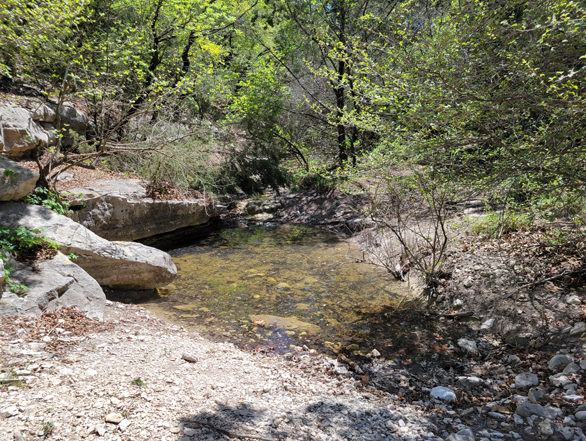
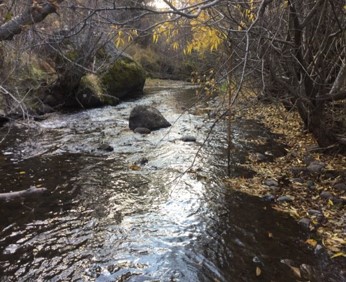
Bioassessment Across Flow Permanence Gradients
Ideally, bioassessment indices would be applicable and directly comparable across the full range of flow permanence and types of flow regimes. However, few bioassessment indices exists for use in nonperennial streams and those that have been developed often perform poorly. In collaboration with the AZ DEQ and BLM, we developed 16 indices and compared how well they performed across the full gradient of flow permanence that occurs in streams of the arid western USA. We hypothesized that we could improve index performance by:
- More accurately and precisely accounting for site-specific natural variability in assemblages associated with flow regimes that occur across arid landscapes and variation in stream connectivity and,
- Incorporating biological traits into indices that are reflective of differences among species in their resistance and resilience to natural, flow-related disturbances.
Additionally, we wanted to determine if single metrics might perform better than multimetric indices (MMIs) and observed/expected taxa composition (O/E) indices. To develop and test indices, we used macroinvertebrate data from 382 reference-quality and 91 physicochemically-degraded streams that spanned a wide range of flow regimes in the western USA. We developed 2 versions (with and without novel measures of flow regimes and hydrologic connectivity) of 8 different candidate indices: 2 modeled MMIs (mMMIs), 2 traditional taxa-based O/E indices, 2 trait-based O/E indices, and 2 modeled richness metrics (insect and EPT richness). For the mMMIs, we developed indices based on both traditional candidate metrics as well as metrics based on biological traits thought to be reflective of adaption to drying. For all candidate indices, we used random forest models to account for natural variation among sites. Candidate predictors in these models consisted of 33 traditional landscape-scale predictors and 20 novel measures of flow regime and hydrologic connectivity. We quantified the precision, accuracy, responsiveness to degraded conditions, and sensitivity of all indices in general and across inferred flow-permanence gradients. Additionally, we validated the top-performing index using an independent set of California streams for which flow permanence was known and compared its performance with the California Stream Condition Index (CSCI), which was initially developed for perennial streams.

Performance of top performing indices varied across inferred flow-permanence gradients, with 75-90% and 47-56% of degraded streams classified as being in nonreference condition for perennial and the driest, most isolated streams respectively. Inclusion of novel measures of flow/connectivity or resistance/resilience biological traits into indices did not improve index performance. Simple, modeled richness indices performed just as well as, if not better than, more complex indices, including the CSCI. Therefore, modeled richness indices may be practical, intuitive measures of biological condition universally applicable to streams in regions with both nonperennial and perennial streams. Additionally, predictions of reference-condition richness were based on random forest models that used landscape-level predictors readily available from the National Hydrography Dataset and the USEPA’s StreamCat dataset, so these indices could easily be developed in other areas of the USA and elsewhere. However, the precision, and hence sensitivity, of all indices declined markedly when the percent of stream km that were nonperennial within 25-km of an assessed site exceeded 80%. Binning sites into 3 connectivity classes (<60%, 60-80%, and >80% of stream length classified as nonperennial within the 25-km buffer) could serve as an objective and biologically meaningful way of setting thresholds for inferring impairment.