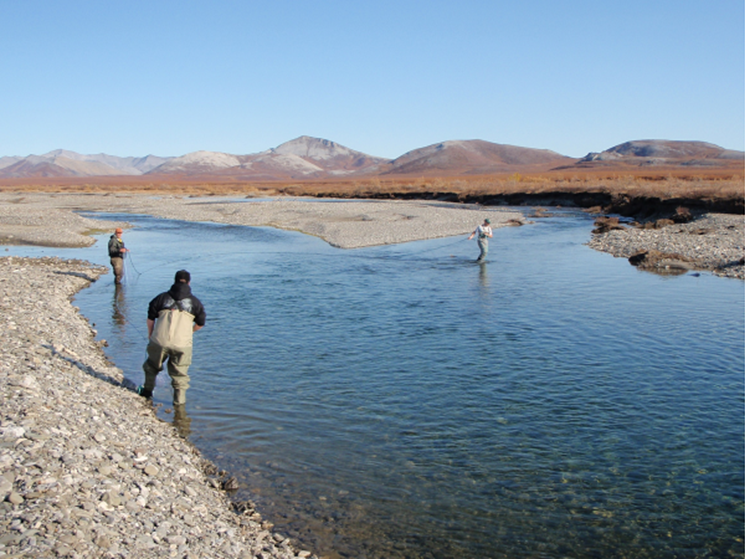
Development and Implementation of Biological Assessment Tools for Wadeable Streams in Eastern Alaska
Mining and other anthropogenic activities have potentially impacted stream ecosystems across eastern Alaska, including in Denali National Park, Wrangle-St. Elias National Preserve, and Yukon-Charley Rivers National Preserve, but there has never been a comprehensive, quantitative assessment of those impacts. The purpose of this agreement is to provide that assessment, and to create an optimal macroinvertebrate bioassessment tool for eastern Alaska for use in wadeable stream systems. We seek to develop bioassessment indices that can be applied at both the stream reach and regional scales to make accurate and precise biological condition determinations. A bioassessment tool developed for use at multiple spatial scales will be highly valued by the various agencies that collect macroinvertebrates as bioindicators of stream condition in eastern Alaska, including the National Park Service (NPS), the Bureau of Land Management (BLM), the Alaska Department of Environmental Conservation (ADEC), and the U.S. Fish and Wildlife Service (USFWS). By leveraging extensive benthic macroinvertebrate data collected by the NPS and other agencies both inside and outside of the park units, including the ADEC, the USGS, and the BLM, we should be able to substantially increase the precision and sensitivity of stream condition assessments in eastern Alaska. However, these systems are subject to frequent disturbances which may mask efforts to detect anthropogenic impacts on biological indices. For this project, we will develop O/E and MMI indices to determine if we can develop an index with sufficient performance for use by the NPS and BLM in this region of Alaska.