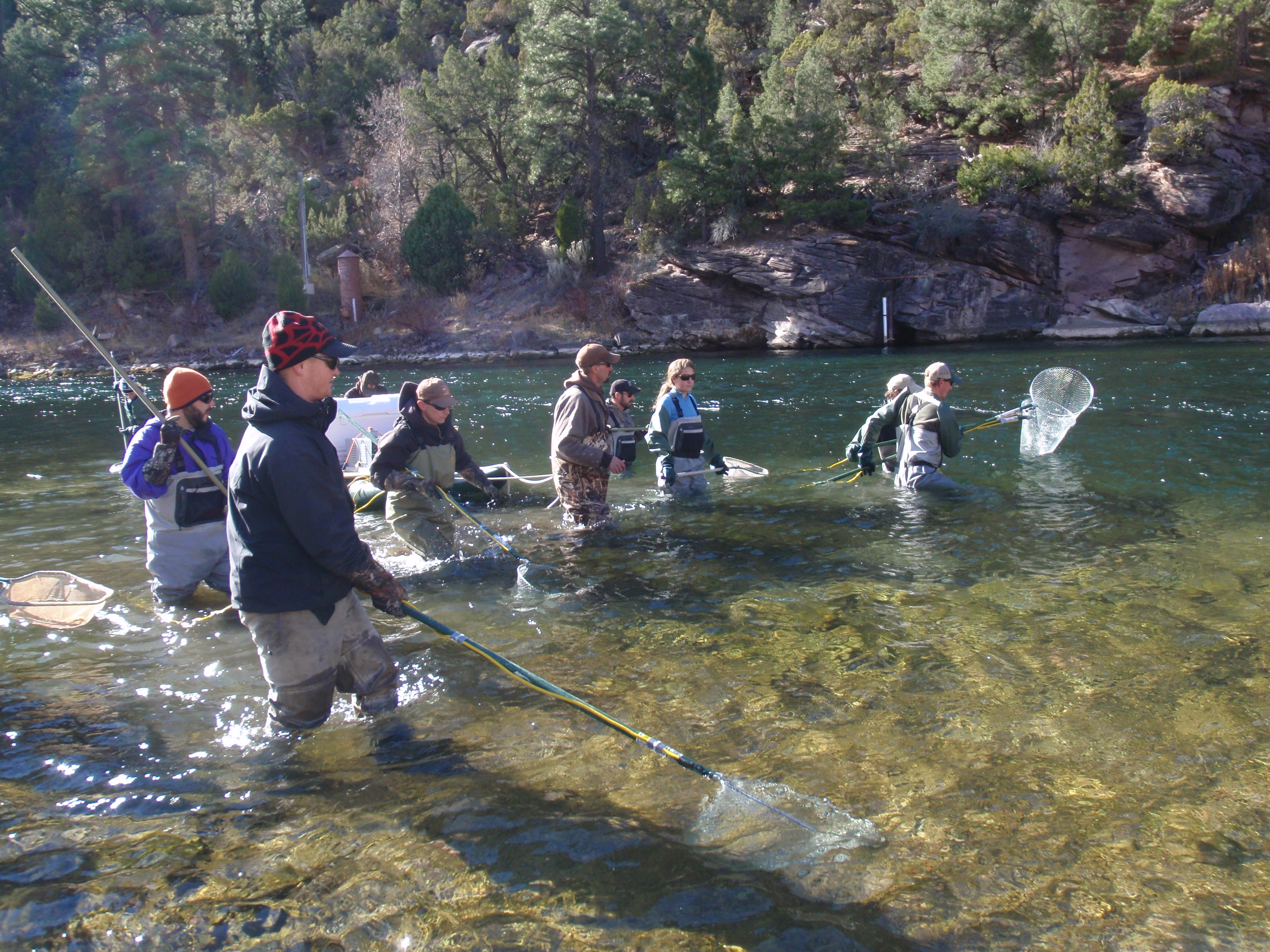
Responses of Macroinvertebrate Drift, Benthic Assemblages and Trout Foraging to Hydropeaking
The National Aquatic Monitoring Center is working to quantify responses of macroinvertebrate drift, benthic assemblages and fish consumption patterns to double-peak hydrologic releases. Our results suggest that discharge changes have a greater impact on drift export than absolute flow levels, such that drift biomass was significantly higher (171 %) during double-peak as compared to single-peak release patterns. Drift increases were proportional to peak magnitude; however, increases were only sustained for two of four months. Similarly, at hourly time-scales, drift biomass was highest during the rising limb of the hydrograph and increases were not sustained for the duration of individual peaks. Both short- and long-term hysteresis was related to patterns in organic matter export, principally the filamentous algae Cladophora glomerata. Increases in macroinvertebrate drift did not significantly reduce benthic density or richness, but gut fullness for brown and rainbow trout was significantly greater following periods of peak flow. Our results suggest that the effects of food resource availability on trout fitness cannot be considered independent of discharge fluctuations at both daily and monthly time-scales.
Collaborators
- Utah State University
- Utah Department of Wildlife Resources
- Western Area Power Administration
- Argonne National Laboratory