
Disturbance Ecology

Wildfire and Forested Ecosystems
Fire is a vital part of western forested ecosystems and always has been. Virtually every forest type in the western U.S. has evolved with fire on some temporal and spatial time scale. Fire reoccurrence in forested systems has varied from only a few years, like in ponderosa pine types, to many hundreds of years, as is likely in high elevation spruce-fir ecosystems. Extant forests and tree-ring records can tell us about relatively recent disturbance events, but longer-term understanding of fire is possible by using lake bottom sediments - that can stretch back up to 14,000 years for many montane forests in Utah. Better understanding how wildfire and other disturbances shaped past landscapes is crucial for building natural disturbance-based silvicultural approaches to regenerating contemporary forests.
Related Literature:
Blomdahl, E.M., J.H. Speer, M. Kaye, N.E. Zampieri, M. Rochner, B. Currey, D. Alving, G. Cahalan, B. Hagedorn, H. Li, R. Oelkers, L. Pelletier, I. Thapa, K. Willson, B.D. Woodward, and R.J. DeRose. 2022. Drivers of vegetation change in high elevation forests of the Greater Yellowstone Ecosystem. Journal of Vegetation Science 33:1-14. (link)
Morris, J.L., A. Brunelle, R.J. DeRose, H. Seppä, M.J. Power, V. Carter, and R. Bares. 2013. Using fire regimes to delineate zones in a high-resolution lake sediment record from the western United States. Quaternary Research 79:24–36. (link)
DeRose, R.J. and J.N. Long. 2012. Drought-driven disturbance history characterizes a southern Rocky Mountain subalpine forest. Canadian Journal of Forest Research 42:1649-1660. (link)
Bark Beetle Outbreaks
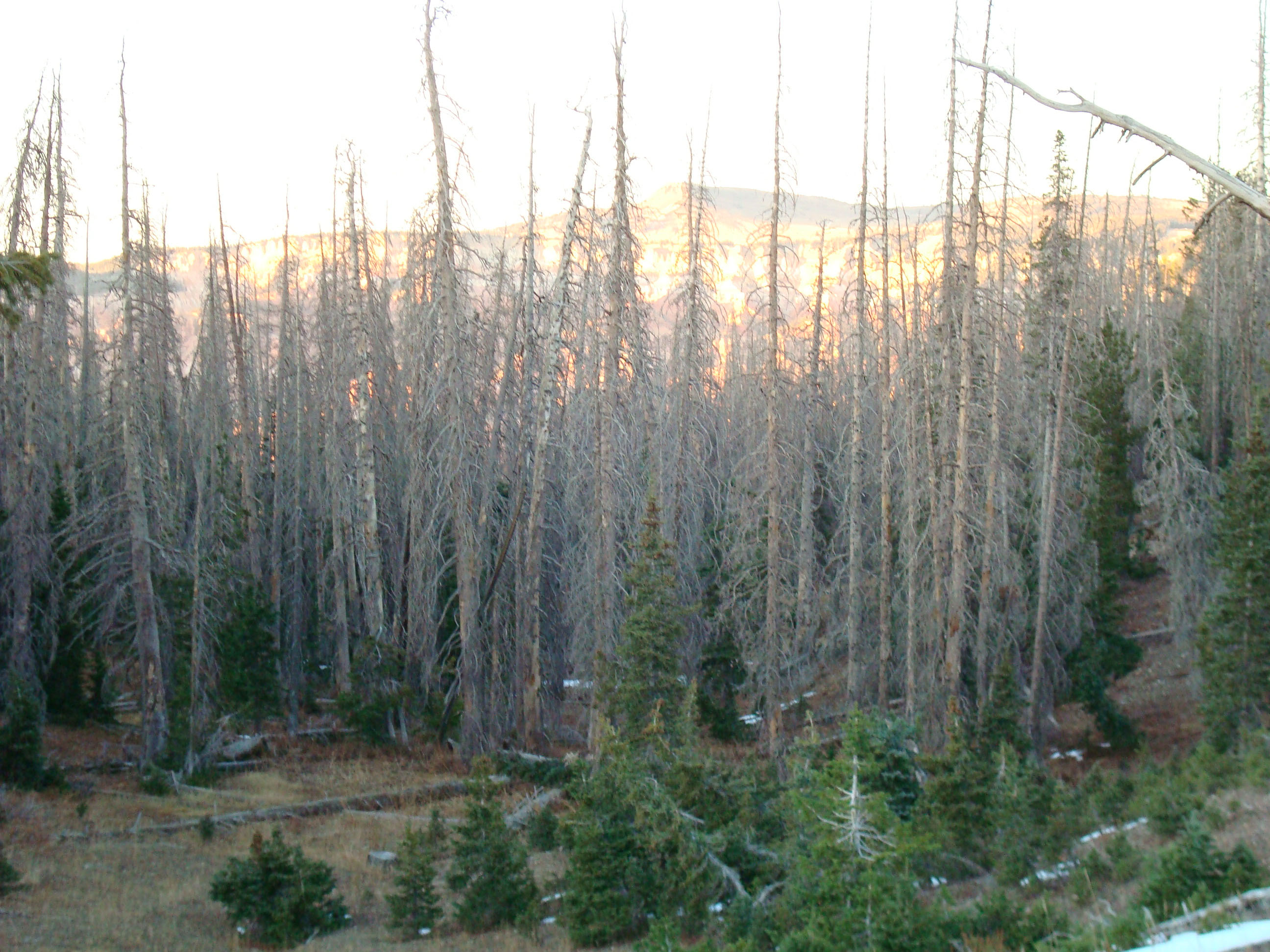
Bark beetles are native insects that occur in forests of western North America. While playing an important role of biomass turnover at endemic levels in virtually all forested systems, these insect populations can build to epidemic population levels and kill large numbers of mature trees. Recent decades have seen bark beetle outbreaks more extensive and severe than any other in the historical record. Concerns about the future of forests affected by such large-scale outbreaks are many and include regeneration failures, species shifts, and type changes. Better understanding why and how beetle populations develop can help us better prepare for future outbreaks, and to manage forest structure and composition in a way that reduces the risk of beetle populations reaching epidemic levels. Beetle outbreaks and wildfires can interact in space and time, where the occurrence of one can increase or decrease the occurrence of another. Better understanding these interactions will be important for improved forest management.
Learn about the spruce beetle outbreak on the Markagunt Plateau in southern Utah.
Related Literature:
Pettit, J.M., S.L. Voelker, R.J. DeRose, and J.I. Burton. 2020. Spruce beetle outbreak was not driven by drought stress: evidence from a tree-ring iso-demographic approach indicate temperatures were more important. Global Change Biology 26(10): 5829-5843. (link)
DeRose, R.J., M.F. Bekker, and J.N. Long. 2017. Traumatic resin ducts as indicators of bark beetle outbreaks. Canadian Journal of Forest Research 47:1168-1174. (link)
DeRose, R.J. and J.N. Long. 2014. Resistance and Resilience: a conceptual model for silviculture. Forest Science 60:1205-1212. (link)
DeRose, R.J. and J.N. Long. 2009. Wildfire and spruce beetle outbreak: simulation of interacting disturbances in the central Rocky Mountains. Ecoscience 16:28-38. (link)