
Type I Interferon Receptor (IFNAR) Knockout Sheep

Interferon alpha (IFNA) and interferon beta (IFNB) are type I interferons produced by cells infected with viruses. IFNA and IFNB are important for protection against viral pathogens because they trigger an innate or early response, which controls a viral infection until an adaptive immune response develops. IFNA and IFNB both interact with the type I interferon receptor (IFNAR), which is a heterodimer made up of two subunits: IFNAR1 and IFNAR2. Mice lacking the IFNAR are used routinely for studying viral pathogenesis, and for testing viral vaccines and antiviral drugs. We have produced genetically modified sheep with IFNAR2 inactivated on either one (IFNAR2+/) or both (IFNAR2–/–) chromosomes. We expect that these sheep will become an important large animal model for studying immune responses to viral infection.
Although IFNAR knockout sheep were initially produced as a model for studying immunity to viral infections, ruminants are unique in that they use a type I interferon, interferon tau (IFNT), for pregnancy recognition. At a critical time in early gestation (days 12-15 in sheep and goats), trophoblast cells of the placenta secrete IFNT which acts as a signal to the mother to maintain the corpus luteum and not return to estrus. IFNT is believed to work exclusively through the IFNAR. Consequently, our IFNAR knockout sheep are also a valuable model for studying pregnancy recognition in ruminants.
Figure 1
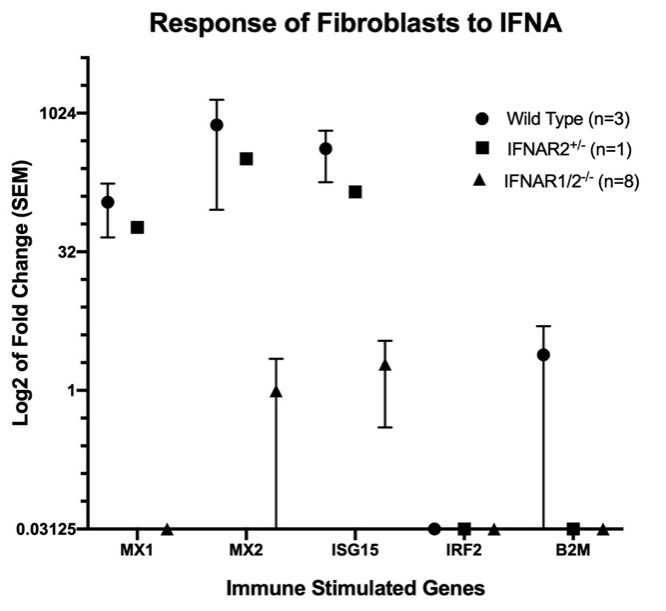
Figure 1: qRT-PCR analysis of fibroblast responses to human IFNA. Data were normalized using the average expression of four housekeeping genes: GAPDH, ACTB, YWHAZ and EIF4A1. The IFNAR1/2–/– group (IFNAR1–/– and IFNAR2/– sheep) differed significantly from WT sheep for MX1 (P=0.02) and ISG15 (P=0.01), and approached significance for MX2 (P=0.07; pairwise comparisons using Student’s test).
Figure 2
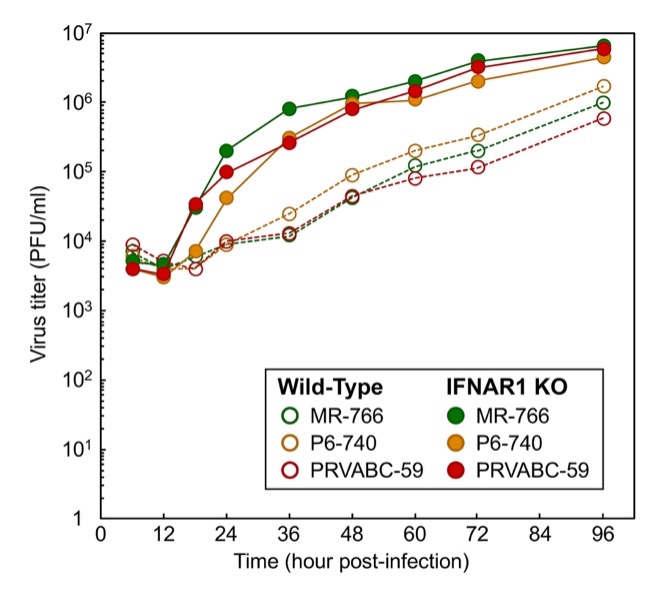
Figure 2: Comparison of viral titers in supernatants from wild-type (WT) and IFNAR1–/– fetal fibroblast cells. Three strains of genetically divergent, historically important, and regionally and temporally distinct Zika virus were used: MR-766 (African), P6-740 (Asian) and PRVABC-59 (American).