
Paleoseismic trench sampling
Luminescence dating can be applied to paleoseismic research to quantify surface-faulting earthquake timing, earthquake recurrence intervals (mean repeat time of earthquakes), and fault slip rates. Sample quality greatly affects the age calculation in this particular setting given the short transport of material during a seismic event. Therefore, extra care and detail should be paid when sampling for paleoseismic research. A few important highlights are mentioned here, but we strongly urge you to review the full guide by Gray et al. 2015 for details.
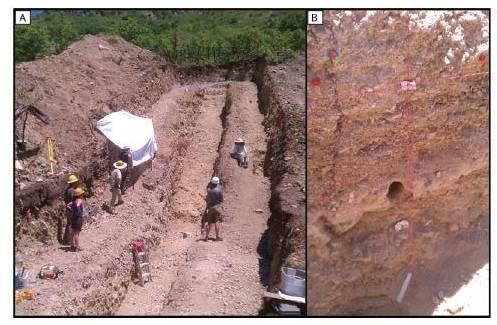
(A) Typical paleoseismic trench in a coarse alluvial-fan setting.
(B) Example luminescence age sampling location on the trench wall. Note the sample is in a sandy layer between coarse, poorly sorted layers. Sample site hole is approximately 15 cm in diameter. Hole is larger than tube used for sampling.