
Welcome to Our New Proposal Specialist, Dr. Amelia Miller!
1/22/2026
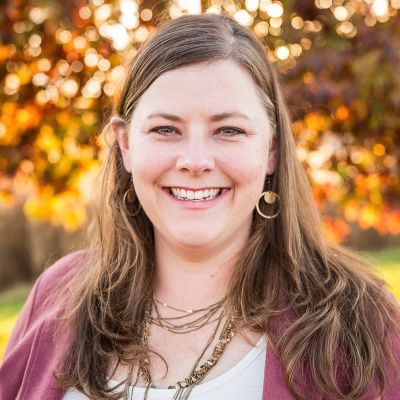
Amelia Miller joined our team in the new year as an additional Proposal Specialist. She is a two-time Aggie alum, with a PhD in Career and Technical Education. She is bringing prior experience on the PI and researcher side of grant writing to our team. Amelia previously worked for the National Center for Agricultural Literacy, housed in the Applied Sciences, Technology, and Education Department and at Cornell University.
Statistical Consulting Service at the Utah Agricultural Experiment Station (UAES)
Xin Dai, Ph.D.
9/12/2025
One day, a researcher knocked on my door, asking if she could ask a five-minute statistical question. The question was how to determine the sample size needed for a planned research project seeking external funding. Instead of five minutes, our conversation lasted over half an hour and ended with me giving her a list of the information I needed to give her the numeric answer.

On another occasion, a graduate student walked into my office with a laptop, showed me the data collected for his dissertation, and asked if he could finish all the necessary statistical analyses before his defense in three weeks. The answer was no. Graduate-level research involves multiple years of experiments, either continuation of previous ones or different experiments by year, which requires evaluation of the data collection process and the quality of data, and determination of appropriate methods to analyze each type of the responses. At the first consultation with the student, it turned out that the experiment was not replicated for one treatment factor, and this unexpected twist of the planned study required additional effort to weigh pros and cons of possible actions.
The list can go on. To consult a statistician at the planning stage of a study and reserve enough time for statistical consultation and analysis would largely save you from these pitfalls while writing later. At UAES, I am the consulting statistician to assist faculty and graduate students with study design, data analysis, and interpretation of results related to UAES-supported research projects.
Here are the answers to some frequently asked questions from faculty and grad students about statistical consultations.
What tasks does Dr. Dai help proposal writers with?
- Study design. Based on your research questions, Dr. Dai can help you evaluate different study design options and determine how large a study to perform to achieve the desired results.
- Data quality management. Data arrives in different formats, and variables are of different types. Errors occur during compilations and entries. Dr. Dai provides guidance and assistance to help you tidy your data and prepare it for analysis.
- Data analysis. Dr. Dai assists you to determine the appropriate analytical methods for your data based on how it is collected, and what research questions to address.
- Result interpretations. Dr. Dai can also help to interpret results from an analysis performed either by you or someone else.
How much time does she need to do her work? (Or, how early in the project should the PI ask her for help?)
The preferred time to contact a consulting statistician is at the planning stage of a study. A statistician has the technical knowledge and experience to help you select the appropriate design for obtaining research-objective-oriented data. Experiment design includes associated analytical methods. When a design is determined, a corresponding analysis plan is put in place at the same time. Time required for a sample size/power analysis varies case by case, depending on the research hypothesis, complexity of the design, and domain-knowledge of the researcher.
With all the necessary information available, sample size calculation/power analysis generally can be completed in a week. For a data analysis project, expect 4-8 weeks turnover time, depending on the statistician’s workload. A long-term experiment involves continuing updates of data availability and analysis.
May I ask Dr. Dai for help if I don’t have a UAES appointment/project?
Yes. However, while the consulting statistician serves faculty and graduate students in QANR on their research projects, priority goes to UAES projects.
How do I request help?
Submit the “Statistical Request Form” at the UAES resource page. You may submit the form for each new project, but it’s not necessary for successive consulting sessions on the same project.
Should a consulting statistician be included as a coauthor on a scientific paper?
Collaborative work is inherent in being a consulting statistician. Most scientific journals regard statistical analysis as intellectual input sufficient for authorship. In general, a statistician has a right to coauthorship if the statistician writes part of the paper, contributes substantially to the design and analysis, or puts in a substantial amount of time revising the manuscript for intellectual content.
What help does Dr. Dai give to grad students?
A consulting statistician does not run all the statistical analyses for a thesis or dissertation, even with a coauthorship on manuscripts originated from the thesis/dissertation. In this case, a graduate student is expected to collaborate with the statistician on analytical tasks of the research project for their degree.
What misconceptions do researchers have about using statistics in their projects?
Do not pressure a consulting statistician to do what you want for achieving a predetermined outcome. This may adversely affect the credibility of the study results, and the statistician. No one can guarantee that the results of an analysis will be exactly what was hoped for. However, a statistician with knowledge and understanding of statistical methods is equipped to establish a study and draw valid conclusions defensible in the light of criticism. Besides, a statistician identifies limitations to the conclusions that may lead to future research.
Your QANR Grants Team: Greg Podgorski, Grants Editor
8/28/2025
Your QANR Grants Team: Greg Podgorski, Grants Editor
Greg is an Emeritus Associate Professor of Biology and Associate Dean of Undergraduate Programs for the former College of Science. He’s been associated with USU for nearly 40 years and has worked as a grants editor for more than 15 years. Although Greg’s academic expertise is in the molecular and cellular areas of biology, with a Ph.D. in Molecular and Cellular Biology and an M.S. in Biophysics, he’s worked with investigators doing research across the full span of interests in QANR.
What does he do on the grants team? Greg’s primary role is to carefully review the final draft of your proposal. He looks for alignment with the RFA, clarity of the writing, logic of reasoning and strength of arguments, and the overall attractiveness of your proposal to reviewers. He provides feedback in all these areas. Greg knows he’s not an expert in most of areas of the proposals he reviews, and that can only make predictions about what reviewers might think of a proposal, but he is able to provide an objective, thorough review of your proposal along with suggestions for improvement ahead of it reaching hyper-critical agency reviewers. Many investigators have found his services to be valuable.
In addition to a review of your final draft, Greg is also happy to discuss your ideas for a project in the planning stages. Once again, while he may not be an expert in your area of science, his experience in what proposals have been funded can make him a useful partner in the proposal development.
To schedule a review from Greg, work with your grants specialist. Plan ahead. He’ll need five working days for the review, and you should plan on at least a week ahead of the SPO submission deadline to make any changes to your proposal.
News from the QANR Grants Office
7/31/2025
We are now officially the S. J. and Jessie E. Quinney College of Agriculture and Natural Resources! As you gear up for the new school year and plan your FY26 funding strategy, you may be wondering about the structure of the Grants Office. Let us reintroduce ourselves and tell you how we can support you in developing successful grant proposals!
Meet the QANR Pre-award Grants Team!


Juan Villalba is our new Associate Dean for Research, and he is committed to supporting your grant writing and all your research endeavors here in QANR. With a Ph.D. in Range Science, Dr. Villalba is a professor and a researcher in the Department of Wildland Resources and leads the transdisciplinary multistate project Smart Foodscapes at USU.
Katie Dana is well known for her years as a Proposal Specialist and Business Manager in QCNR. She has an impressive breadth of experience and is known as a skilled budgeteer and fierce advocate for PIs. She spends half her time in QANR and half in the College of Veterinary Medicine.
Cody Bills has a PhD in virology and is our STEM warrior! He is a huge help to PIs because he has a firm understanding of both the research and the grant writing skills necessary to succeed. He can help you develop and refine attractive graphics for your proposal. He is also the team point of contact for early investigator grants and webmaster for the QANR grants team page.
Bonnie Schenk-Darrington is the arts-humanities-social sciences expert on the QANR team. She runs the proposal helpdesk and curates the Research Funding Update newsletter. She loves to help PIs find potential funding sources. She specializes in large proposals and helped prepare and submit the first two NIH P01 proposals in USU history.


Hollie Richards is well known in Geosciences as a “unicorn”: She is a Business Manager with mad skills in Kuali! She expertly finesses all the obscure and complicated budget types. She will handle Geosciences proposal submissions for the college, at least for the foreseeable future.
Greg Podgorski is our intrepid proposal editor. He is our secret weapon! You may know him from his time as the Associate Dean for Undergraduate Programs in the College of Science. Now he is partly retired but still kindly reviews proposal narratives for us. If you would like to schedule his services, please don’t contact him directly. Instead, ask a proposal specialist to reserve a spot for you on his calendar. Request a review early! He cannot do last-minute reviews because you’ll need time to revise.
Xin Dai is a consulting statistician at Utah Agricultural Experiment Station, Utah State University. She provides support in design, analysis and interpretation of research for faculty and students in agricultural sciences. Reach out to her early on in the planning stage to get help designing a study for specific research questions and outlining the corresponding statistical analysis steps.
Sarah Baker is our new pre-award Sponsored Programs Officer. She has been a proposal analyst helping USU PIs submit compliant and competitive proposals since early 2024 and has worked at USU in various roles since 2021. We’re very lucky to have her on our team.
Please note that our beloved Pam García has retired and Mikayla Cook has left us to attend law school. We wish them all the best in their new adventures!
What Services Does the QANR Grant Office Provide?
We provide help with . . .
- Kuali and budget creation;
- Document lists, templates, and timeline planning;
- Reaching out to program officers with questions or sitting in on meetings with program officers;
- Developing and refining figures and charts;
- Connecting you with potential collaborators from across the university;
- Helping you format, compile, and curate documents;
- Discussing ideas and approaches for your proposal; and
- Narrative reviews and various editing tasks.
Requesting Assistance
If you know which grant you’d like to apply for, please complete a request for assistance through our ServiceNow Helpdesk and we will reach out to you within two business days to get started:
It’s important to ask us for help as early as possible. Our work takes time, depends on multiple people, and some administrative processes cannot be rushed or bypassed. We ask for at least four to six weeks to put together a proposal wherever possible. Proposals are handled on a first-come, first-served basis. We cannot ignore existing projects over last-minute proposals. Without adequate time for preparation, we may not be able to provide assistance, but we will do our best to help you, time permitting.
Meeting with Proposal Specialists
Please reach out to Bonnie Schenk-Darrington to schedule the following:
If you are a Department Head and would like us to come to your Faculty Retreat to introduce ourselves; or
If you are a new faculty member and would like a New Faculty Grants and Proposals Orientation meeting.
You’re also always welcome to give the proposal specialists a call or send an email with a question or meeting request. If you’re not quite ready to submit a proposal, we are happy to listen to your ideas or try to help you find a grant for a specific project.
Some QANR and USU Grants Resources
- QANR Research and Grant Resources:
https://agnr.usu.edu/research-and-grant-resources/ - QANR Grants Office Helpdesk:
https://usu.service-now.com/aggies?id=caashd - GrantForward:
https://www.grantforward.com/welcome - SPO Government Updates:
https://research.usu.edu/government-updates/ - USU’s Internal Deadlines for Proposal Submission:
https://research.usu.edu/spo/policies - SPO Fringe Rates for Proposals:
https://research.usu.edu/spo/develop-proposal/benefit-rates - USU Libraries Data Management Plans and DMP Tool:
https://library.usu.edu/data-management/data-management-plan - USU Libraries Books on Grants:
https://libguides.usu.edu/c.php?g=52517&p=338583 - Office of Research Fall Proposal Writing Seminars:
- Faculty: https://research.usu.edu/rd/faculty-gw-seminar
- Arts and Humanities: https://research.usu.edu/rd/arts-humanities-gw-seminar
- Grad Students: https://research.usu.edu/rd/grad-gw-seminar
Submitting Proposals at USU
11/20/2024
Submitting a proposal to a sponsor can be a daunting task. USU and AGNR have staff in place who will help you to submit a proposal that is on time, polished, and compliant with state and federal law and university policy.
There are two entities involved in your submissions:
USU Sponsored Programs Office (SPO)
USU policy is that the full Kuali proposal with departmental/college approvals is due to SPO four full business days prior to the deadline (essentially, everything should be done and submitted in Kuali at least a week prior to the deadline, as it can take a few days to get approvals, depending on the availability and responsiveness of the approvers).
If the Kuali work is done on time, SPO guarantees a timely submission. If we are late getting approvals on the finished Kuali proposal, SPO will do their best but cannot guarantee a timely submission, as frequently many people submit to the same deadline (and all want to submit as late as possible), leaving SPO with many projects to review and submit in the same four-day window. Usually, they all get submitted but there have been times when the PI didn’t get the project completed in time and SPO was not able to submit due to other commitments (other PIs who complied with the required time frame), or because sponsor portals have occasionally crashed when many institutions are all trying to submit at the same time. On-time and early submissions save you from this heartbreak. There are also consequences to the PI for submitting late and last-minute proposals. You can read more about the SPO deadlines here.
AGNR Grants Office
The Grants Office, in general, helps PIs with two types of Kuali files: contracts/agreements and grant proposals.
Contracts/Agreements: These usually take less time to prepare but can take several days, depending on the speed of communication and the stage of finalization of the documents the PI prepares. They are also dependent on the workload of the Grants Office at the time, as time is committed to the PIs on a first-come, first-served basis. A good minimum time frame for contracts/agreements is two weeks for the Grants Office and one week for SPO (total three-week lead time).
The process for a contract or agreement is as follows: The PI informally discusses a potential project with their collaborator/sponsor contact. The sponsor likes the idea of it and the PI states that a formal USU-approved scope of work and budget are forthcoming.
The PI works with the AGNR Grants Office to create a Kuali proposal and finalize the SOW/budget details. After routing, the assigned SPO Proposal Analyst submits the scope of work and budget to the sponsor for their approval. You should not commit a scope or budget to a sponsor without internal approval of that scope and budget by your AGNR unit approval queue and SPO.
Once the sponsor agrees to fund the project as proposed, they may send SPO either a draft agreement or a notice of award and request for USU to draft an agreement. The assigned SPO Grant & Contract Officer can then review the agreement against the proposal, negotiate any terms as needed, and get it signed. Please don’t try to negotiate or sign an award on your own. It is USU policy that SPO is the entity given this authority on behalf of the University. If you are working with a potential sponsor and need assistance, please reach out to SPO.
For contracts and agreements, you’ll need the following documents:
- Scope of work
- Budget
- Budget Justification
- If less than full indirect costs (also called F&A or overhead costs) are requested, we need a published statement from the sponsor limiting indirect costs or we need a Dean’s Waiver of F&A form with a justification for the reduction in indirect costs. This is not guaranteed; the Dean will consider and decide whether or not to approve.
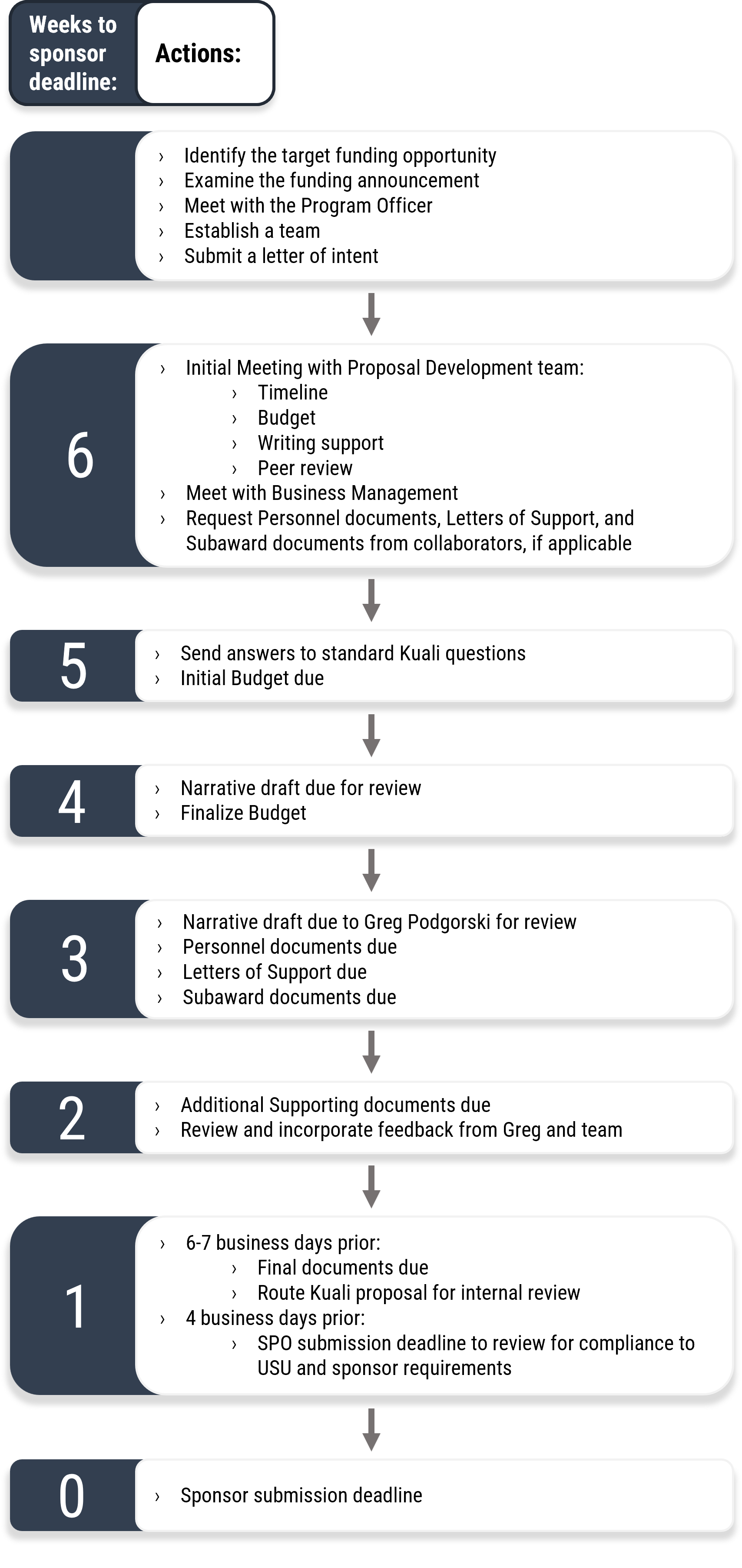
Grant Proposals: Generally, grant proposals require several months’ prep time for the PI. When the PI knows they will be submitting a proposal, they should put in a ticket at the AGNR Grants Office Helpdesk. When a proposal specialist gets the ticket, they contact the PI and prepare a checklist of required documents and their descriptions/instructions, and a timeline for the PI to approve and commit to or suggest revisions. A typical timeline for developing a proposal is shown on the right.
It’s important to stick to the timeline because multiple proposals are being prepared at the same time and it’s necessary to plan enough time for everyone to get the support they need. When people miss the deadlines on their timelines, they move from being the priority project for their scheduled time to being secondary or tertiary priority for the timeframe when they do submit the documents (fitted in as time allows around the other PIs who have kept to the committed timeline). The AGNR Grants Office requests at least four to six weeks to get the proposal prepared and submitted.
In the same vein, communication about a proposal budget should start well before the deadline for the final budget—at least a week before the proposal specialist’s final budget deadline. The proposal specialist will need to know the project’s start/end date, list of personnel, % effort to be committed for each person, student information (% summer/% academic, rate of pay, hours to be worked for undergrads). Work with your proposal specialists early to get the exact costs from Kuali so you don’t have to rebudget at the last minute to get the correct salary or benefits amounts (not to mention, rewrite your proposal narrative because you realized you couldn’t stay in the sponsor’s budget limit and still afford some of the line items you originally wanted). The reason you should work on a draft budget at the beginning of the proposal process is to give time for some back-and-forth between you and the proposal specialist, if required (if you need to adjust effort levels to stay within the budget limit, for example).
Other things that add time to the timeline are subawards, cost share, and reviews or edits by the Grants Office Team. Things that add time to the approval process include having key personnel from multiple departments or colleges, since all the associated key persons, financial officers, department heads, and deans must all approve the final Kuali file. Keep in mind, also, that some times of year are busier for Grants Office and SPO staff than others, such as the period when AFRI Foundational and Applied Science Program grants are due (July 31 – October 31).
The AGNR Grants Team are your partners in submitting compliant proposals on time. Thank you for the your efforts to follow the submission timelines and policies.
Proposal Development Timeline
Updates to the Uniform Guidance, the Document Governing Federal Grants and Cooperative Agreements
Amber Buatte, Executive Director of the USU Sponsored Programs Office
10/17/2024
Federal grant financial rules are changing in multiple key areas. Please work closely with your Proposal Specialist, Business Manager, and Sponsored Programs Grant & Contract Officer as you craft your proposal budgets.
The Federal Government has updated Title 2 of the Code of Federal Regulations (CFR), including 2 CFR part 200, which is generally referred to as Uniform Guidance. Uniform Guidance outlines the rules and regulations pertaining to federally funded grants and cooperative agreements. These changes went into effect on October 1, 2024, and apply to all new awards issued on or after that date, as well as existing awards when the sponsor adds new funding. The table below summarizes the most pertinent changes that PIs, Co-Is, research support staff, and Business Services should be aware of:
| Topic | Update |
|---|---|
|
Prior Approval for Personnel and Contractor Changes |
Changes to key personnel (employees and contractors) listed by name or position in an award notice require prior approval before changes can be made. PIs should carefully monitor which individuals and entities are included in each award notice so they can work with SPO to request prior approvals when needed. |
| Cost Sharing | For research grants, voluntary committed cost-sharing can only be used in merit review if authorized by the agency. For research and non-research grants, the funding announcement must specify how any cost-sharing proposed by an applicant will be considered during the proposal review process. USU’s policy to only provide cost share when required by the funding announcement remains unchanged. |
| Equipment Threshold | The revised Uniform Guidance increases the Capital Equipment threshold from $5,000 to $10,000. For USU, this change did not go into effect on October 1, 2024. USU’s Negotiated Indirect Cost Rate Agreement will need to be negotiated using the increased threshold before this will be applicable. More information will be provided prior to this becoming applicable at USU. |
| Supply Threshold | The revised Uniform Guidance increases the supply threshold from $4,999 to $9,999. For USU, this change did not go into effect on October 1, 2024. USU’s Negotiated Indirect Cost Rate Agreement will need to be negotiated using the increased threshold before this will be applicable. More information will be provided prior to this becoming applicable at USU. |
| Unused Supplies at the end of the Award | Each award may retain up to $10,000 (an increase from $5,000) in unused supplies on awards subject to the new rules. These supplies are expected to be used for future federal research projects. |
| Participant Support | Prior agency approval is no longer needed to ADD participant support costs in a budget, but funds still may not be re-budgeted OUT of this category without agency approval. PIs should coordinate budget changes involving participant support costs with SPO. |
| Subaward De Minimus F&A Rate | Subrecipients without negotiated Facilities & Administration (F&A) rates may now charge up to 15% F&A (up from 10%) for proposals submitted on or after October 1, 2024, for grants and cooperative agreements. |
| Subaward MTDC Exclusion | The revised Uniform Guidance increases the Subaward MTDC Exclusion from $25,000 to $50,000. For USU, this change did not go into effect on October 1, 2024. USU’s Negotiated Indirect Cost Rate Agreement will need to be negotiated using the increased threshold before this will be applicable. More information will be provided prior to this becoming applicable at USU. |
Over the next few years, USU will have awards that are subject to the new Uniform Guidance regulations AND other awards that are subject to the previous version of Uniform Guidance. The Kuali award notice will indicate if awards are subject to the new Uniform Guidance regulations. PIs should work closely with their SPO Grant & Contract Officer or Sponsored Programs Accountant if they are unsure which rules apply to their award(s).
What Is “Foreign Support,” and How Should I Report It at USU and in My Proposals?
Bonnie Schenk-Darrington, MA, MTeC
8/9/2024
The protection of American secrets has been a concern in our nation since Revolutionary Army cryptologists deployed strategies in coded communications to win the War for Independence against the British. Today, because our adversaries have grown ever more sophisticated as technology has evolved, these concerns remain relevant. Foreign interference and theft of intellectual property threaten the reputations of researchers and institutions more than ever, and the losses to researchers and the United States economy approaches $600 billion annually. USU, federal sponsors, and the US government have put multiple countermeasures in place in order to stem the tide of intellectual property theft by foreign adversaries.
Vibrant international research and relationships are possible, desirable, and necessary in order to solve the problems AGNR researchers tackle every day. The CHIPS and Science Act of 2022 addressed the need for researchers, research institutions, law enforcement, and intelligence communities to work together to address this threat. There are now multiple layers of reporting requirements in place to facilitate international collaboration and the vetting of international research partners. Some of these reporting requirements take place at the institutional level, and some take place at the sponsor level.
The government tasks institutions with managing and reporting conflicts of interest. This is why, at USU, you must report foreign support, interests, and collaborations in Kuali on a yearly basis, and report new significant financial interests within ten days. It is also why you must report foreign travel to the USU Office of Global Engagement at least 30 days prior to departure. You can read more about these requirements at the USU pages listed below. You can also talk to the Technology Transfer Office for help protecting your intellectual property. Finally, USU also offers researchers free access to a CITI training titled Undue Foreign Influence: Risks and Mitigation.
Reporting requirements vary from sponsor to sponsor, so please check your sponsor’s proposal guide (if one exists) for special instructions, and read calls for proposals carefully. Some solicitations may not allow foreign collaboration, while others may welcome it. Most federal sponsors have webpages devoted to research security, foreign collaborations, and information about reporting requirements. Some of those webpages are listed below. As you work on a proposal, you can direct questions about foreign reporting to your Sponsored Programs officer or to the Research, Integrity, and Compliance officers listed below.
What is considered a necessary report or disclosure? It would be impossible to list every potential situation that should be reported/disclosed. Here are a few possibilities:
Research support, including stipends, room/board, travel money, donations of lab supplies, or compensation in any amount.
Professional activities, including affiliations, appointments, consulting arrangements, and collaborations with foreign persons or entities.
Travel to a foreign country to conduct research.
Recruitment by or involvement in a foreign talent program.
If you are unsure if something should be reported or where/when to report it, you should reach out to the USU Office of Research Integrity and Compliance. They can guide you through the process.
There are multiple people and offices at USU who can help guide you through the process of reporting foreign support. You don’t have to navigate these complex policies alone.
More Information
USU
Foreign Influence in Research: What to disclose/report and to whom.
Conflict of Interest Overview: Foreign influence can represent a conflict of interest (COI). You don’t need to be afraid to report a COI because, per this webpage, “COI is the result of a situation and not on any actions or character on the part of the researcher.”
Export Compliance: Including international shipping of research samples, international visitors, and individual and institutional responsibilities.
Undue Foreign Influence: Risks and Mitigation: CITI course
Devin Hansen: Director, Research Integrity and Compliance
Joy Van Nostrand: Compliance Officer, Research Integrity and Compliance
USDA
AFRI International Partnerships
NIFA Grant Opportunities for Global Engagement
NSF
Research Security at the National Science Foundation: Scroll down to the subheading “Foreign interference and risk mitigation, where you can click on “Learn more about proposal disclosure documents.”
Research Security Training Modules: These modules introduce the basics of research security and reporting.
NIH
Requirements for Disclosure of Other Support, Foreign Components, and Conflict of Interest
Crafting Impactful Grant Proposals in Compliance with Utah HB261
Cody Bills, Ph.D.
7/25/2024
At Utah State University (USU), we are committed to fostering an environment of inclusive excellence. This commitment extends to our grant proposals, which must be impactful while complying with Utah House Bill 261 (HB261). HB261 prohibits universities from “using an individual's certain characteristics in decisions regarding aspects of employment or education,” essentially prohibiting practices of Diversity, Equity, and Inclusion (DEI). While many funding agencies encourage DEI, grant applicants must be careful in how they address DEI in their proposal narratives. Here are some strategies to ensure proposals are compliant:
- Focus on Universal Excellence: Avoid calling out specific groups. Instead, emphasize the commitment to excellence, access, and inclusion for all members of our statewide campus community. Highlight how the proposed project will contribute to academic success, post-graduation readiness, and engagement in scholarly activities.
- Promote Varied Pedagogy: Highlight how the proposed project will utilize varied pedagogical approaches to ensure all students have the opportunity to succeed and excel. This could include innovative teaching methods, evidence-based professional development, or student-centered approaches.
- Support Student Success: Detail how the proposed project will support student success through personalized coaching, mentoring, supplemental instruction, early research opportunities, and peer learning communities.
- Foster a Sense of Belonging: Explain how the proposed project will contribute to a campus climate conducive to belonging. This could involve supporting student-run organizations, offering engaging activities, workshops, events, and services, or creating opportunities for students to explore their civic identity and develop leadership skills.
- Broaden Students’ Worldview: Describe how the proposed project will offer unique experiences that broaden students’ worldview and support their post-graduation career goals. This could include study abroad programs, internships, undergraduate research, or other experiential learning initiatives.
By focusing on these areas, we can craft grant proposals that are impactful, promote inclusive excellence, and still comply with Utah HB261. Remember, our goal is to create a healthy and inclusive campus community where all Aggies can thrive. For questions about compliance, refer to the USU Compliance website.
Generative AI: Your Copilot for Grant Writing
Cody Bills, Ph.D.
5/30/2024
Grant writing is a crucial yet time-consuming process. However, generative artificial intelligence (AI), also known as large language models, has dramatically altered the grant writing process. There is some reluctance to adopt AI due to the lack of clear guidelines from funding agencies on its use in grant writing. Academics have the option to dismiss AI—at least for now—or to fully embrace this cutting-edge technology. Let’s consider some benefits and pitfalls of AI, the limited policy that does currently exist from funding agencies, and which AI you should use.
One of the most notable advantages of using generative AI in grant writing is improved efficiency and productivity, allowing for researchers to devote more time to their actual research. Additionally, AI can ensure a consistent writing style and format throughout the grant application, which is particularly helpful for large, complex grant proposals.
Generative AI also excels in analyzing large datasets and incorporating relevant data into the grant proposal. This feature can be especially useful when tailoring grant applications to meet the specific requirements of various funding agencies. By analyzing past successful grant applications, AI can help tailor the proposal to improve the chances of success. Other benefits include summarizing entire research articles and checking for clarity and grammatical correctness, which can be particularly helpful for non-native English writers.
However, the use of AI is not without its concerns. One of the main issues with the use of AI is the lack of a personal touch. Grant proposals benefit from a researcher’s knowledge and perspective to tell the story of the research, something that AI currently struggles to provide. Another potential pitfall is the risk of misinterpretation. Complex instructions could be misunderstood by the AI, resulting in inaccuracies in the proposal.
Generative AI should be viewed as a tool to supplement the grant writing process, rather than a replacement for human input. The quality of the AI’s output is heavily dependent on the quality of the input data. Moreover, it is essential to always review and edit AI-generated content to ensure accuracy and completeness. Citations have proved to be an Achilles heel for generative AI, as there is a real possibility that an AI will incorrectly cite a source or even hallucinate and provide an entirely made-up reference. It is important to be mindful of the ethical implications of using AI in grant writing. Questions of authorship and accountability can arise when AI is used.
Policies regarding the use of AI in grant writing are nebulous. The NIH and NSF have both made it clear that the use of generative AI such as ChatGPT to analyze and review grant proposals by scientific peer reviewers is prohibited. When a reviewer uploads a proposal to an AI chatbot, that proposal becomes publicly accessible, thereby violating the confidentiality requirements of the peer review process. However, there is still no clear guidance on using AI to write grant proposals—at least not until 2025. For now, researchers are encouraged, but not required, to indicate in the project description how and to what extent generative AI was used to develop their proposal.
As mentioned, researchers should be extremely careful about what materials they upload to generative AI. However, the Microsoft 365 license at USU includes access to Microsoft Copilot, an AI powered by ChatGPT 4.0, which does not retain prompts or responses, protecting personal and university data. This makes Copilot an ideal tool for writing projects that you wish to maintain confidential. Copilot is already built into Windows 11, making it easily accessible. Separately, ChatGPT is available as a free version, powered by the older ChatGPT 3.5, or through a paid subscription you can access the significantly more powerful ChatGPT 4.0. The major advantage of ChatGPT is that you can provide instructions and writing examples to create custom versions of AI to assist with specific tasks.
In conclusion, while there are some concerns with generative AI, there are significant benefits to using AI in grant writing. Indeed, about 50% of this article was written using Microsoft Copilot to demonstrate its capabilities. By using AI responsibly and supplementing it with human review, researchers at USU can leverage AI to enhance their grant writing process. This balanced approach can lead to more efficient and effective grant proposals, ultimately benefiting the academic community and the broader society.
To learn more about using generative AI in grant writing, read the article from Seckel, Stephens, and Rodriguez and visit their GitHub repository to view a simple comparison of various AI tools and find helpful prompts for developing more competitive grant proposals. Find more helpful information about using AI on the USU Office of Research website.
The Best-Ever Grant-Writing Training Experience
Bonnie Schenk-Darrington, M.A., MTeC
5/17/2024
Fast forward
How can you kick your proposal writing into high gear? The answer might surprise you!
The best way to learn how to write effective proposals is to become a proposal peer reviewer. This seems counterintuitive. You’re probably thinking that you need to get more experience writing proposals before you can apply to be a reviewer. You are wrong. Having scores of successful proposals is rarely if ever a requirement. In fact, many proposal reviewers are postdocs and early career faculty.
Instead, sponsors want someone who knows their field, communicates well, and is willing to follow instructions. Besides technical knowledge, sponsors may ask for experience in tasks such as teaching, developing curriculum, program management, or fiscal management/budgeting. Proposal reviewers don’t need decades of experience, but they do need enough experience to be able to answer questions such as the following: Does the science make sense? Is the program doable? Is the budget reasonable? Do the applicants have the equipment, facilities, knowledge, and experience needed to do this project?
There are many great reasons to become a proposal reviewer. Besides giving valuable service to a sponsor, you make connections with like-minded colleagues and program officers. As you review proposals written by others, you gain a more practiced eye for what works and what doesn’t—and that benefits your own proposal writing skills. Especially if you’re reviewing proposals for a program you hope to apply for, it becomes on-the-job training for your own future proposal efforts.
Generally, you must submit some kind of application to be considered. Sometimes, there will be a form to fill out and sometimes you’ll just email a resume or biosketch to a program officer. Because panels want diverse applicants, you may be asked questions about your ethnicity and race. If you are chosen, you will generally receive training or orientation and have a chance to ask questions before you begin reviewing proposals.
You may or may not receive a stipend. If travel is required, the sponsor will generally cover it. Sponsors generally appreciate reviewers and try not to overburden any one reviewer. The firsthand knowledge you gain will pay dividends.
Here are some links to sponsors’ reviewer applications and process explanations.
-
USDA NIFA (You can also find a great article about being a grant reviewer for various types of USDA opportunities here.)
Some other government agencies, such as the Utah Dept. of Agriculture and Food, the Utah Office for Victims of Crime, NOAA, and the EDA post online about their need for reviewers on a program-by-program basis (click on each agency name for a sample request for reviewers from the past). If there’s a particular sponsor/program you’d like to review for, the best thing to do is search them online and just ask the program officer if they’re accepting applications for reviewers. You should also subscribe to their newsletters where applicable so that you know when new grant opportunities (and probably review opportunities) come available.
Wherever you’re at in your career, becoming a proposal reviewer might be just the experience you need to give your grant-writing skills a boost.