
Call for Proposals
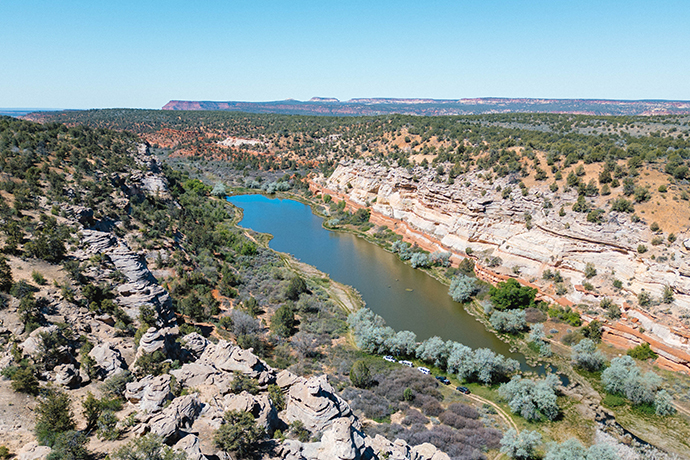
The Utah State University Quinney College of Agriculture and Natural Resources invites proposals from current USU graduate and undergraduate students for applied research at Johnson Lakes Canyon, an 800-acre private inholding within the 2021 boundaries of Grand Staircase–Escalante National Monument near Kanab, Utah.
The property includes a spring-fed wetland and riparian complex and pinyon-juniper upland that have undergone more than two decades of stewardship and restoration, providing a unique setting for research on ecological recovery, restoration, and land management, among other topics.
Awards will support student-designed applied research projects that produce practical information for landowners, public land managers, and/or conservation organizations.
Award
Up to $7,500 per project
Eligibility
Current USU undergraduate or graduate students; individual or group (up to 5 students)
Duration
May be up to 16 months
between October 2026 and March 2028
Application Deadline
September 25, 2026 for full consideration
Priority Will Be Given to Projects That
- Address an applied restoration, monitoring, or management question
- Can be completed within the project period
- Produce findings relevant to Johnson Lakes Canyon and comparable landscapes across the Colorado Plateau
- Align with the 2025 Grand Staircase–Escalante National Monument Science Plan
- Are collaborative and interdisciplinary with small groups of student researchers
Potential Research Topics
- Native vegetation restoration and invasive species management
- Wetland, spring, and riparian system monitoring
- Soil stability and biological soil crusts
- Wildlife habitat responses to restoration
- Hydrology and water quality monitoring
- Beaver dam analogs and other low-tech process-based restoration methods
- Drone, GIS, and remote sensing analysis of landscape change
- Night sky quality monitoring
- Archaeological and cultural resource research, documentation, and stewardship
- Long-term ecological monitoring
- Planning for future research and educational use of the property
Interdisciplinary proposals addressing biological, physical, and/or social science questions relevant to sustainable land stewardship are also encouraged.
A property map is available for those logged in with a USU account.
Application Materials
Applications must include:
- Applicant(s) name, degree program, college, department, faculty advisor, and contact information
- Curriculum vitae or résumé for each applicant
- A project description of no more than two single-spaced pages (11-pt font or larger) that includes:
- Research question and objectives
- Management relevance
- Proposed methods and analytical approach
- Project feasibility and timeline
- Expected broader impacts and public-facing communication
- Data-management and data-sharing plans
- Literature cited (this section does not count toward the 2-page limit)
- A detailed project budget (using this template) with justification for each budget item
- A brief letter or email of support from a USU faculty member willing to supervise the project
Allowable expenses may include field and laboratory supplies, travel, lodging, meals, specialized analyses, field assistance, and living expenses while conducting the research. Priority will be given to proposals that direct most requested funds toward conducting the research.
Expectations for Awardees
Award recipients will be provided scheduled access to the gated Johnson Lakes Canyon property, with total visitor numbers limited to 10 at any one time. Award recipients will be expected to:
- Coordinate field activities with Johnson Lakes Canyon landowners and project leaders
- Follow applicable research, safety, permitting, and data management requirements
- Contribute project data and metadata to a shared geospatial database
- Submit a final report, management brief, dataset, and public-facing project summary
- Participate in a presentation or other activity sharing results with landowners, researchers, and land management partners

Ready to Apply?
Applications are accepted and reviewed on a rolling basis and must be received by September 25, 2026 for full consideration. Projects may begin as early as October 2026 and must be completed by March 2028.
A Zoom Q&A session for interested applicants will be held in early September (date and time TBD).
Submit an ApplicationQuestions?

Peter Howe
Associate Dean for Strategic Academic Initiatives | Professor
(435) 797-9457
AGRS 429
peter.howe@usu.edu